So, I saw the Coen brothers' latest film last night. I've liked most of their films that I've seen but I came out of the cinema feeling disappointed.
I've been mulling over why that might be since then and I think it basically comes down to this. While the events the film revolves around should make for either a gripping thriller or laugh out loud comedy, what you see on screen feels like most of the interesting story scenes got left on the cutting room floor in a bid to get the run time down. This is a shame as the cast are good, although criminally underused in the case of Jonah Hill and Scarlett Johansson.
Perhaps this would have worked better as a TV series where the different threads of the story could have been given more time to be explored.
Friday, 11 March 2016

Friday, 8 January 2016
Star Wars: The Force Awakens thoughts
I got round to seeing The Force Awakens the Monday before Christmas, having been determined to see it at the cinema and to make every effort I could to do so. Like pretty much everyone who grew up with the original trilogy I'd been burned by the prequels, so, even though George Lucas' fingerprints weren't going to be anywhere near the new films, I was still pretty nervous about what to expect.
Ahead of the film's release I watched the official trailers but otherwise tried to avoid any possible spoilers or news about the film. While I obviously didn't want the story spoiled before I went to see it, I also didn't want to run the risk of having my expectations raised or lowered above what the trailers managed to achieve.
I'd initially planned to post my thoughts up not long after seeing the film but with all the preparations for Christmas and sorting things out afterwards, I didn't get a chance to finish writing until now. While I had planned this to be about my first impressions of the film, realistically my views are probably going to be coloured by the various opinions I've been exposed to since seeing the film. Just in case you haven't seen the film yet, I must say I'll be discussing plot points of the film, so come back later if you don't want it spoiled.
So, the big question then, what did I think of it? My first thoughts were that it was just OK, although I'm now leaning towards somewhere between OK and good.
I liked most of the first two thirds of the film, where we got to meet Finn, Rey and Poe Dameron and see their stories develop, as well as catch up with Han Solo and Chewbacca.
There were a few things I didn't particularly like about the film. First off, the last stage of the film is another "we've got to stop the superweapon" plot, which makes you feel like the First Order (or indeed, the writers) haven't really moved on from the original trilogy. Hopefully that'll be the last we see in this trilogy. In fact, while the odd throwaway reference to the original trilogy is fine, The Force Awakens went a bit too far in places in referencing or re-using plot points from the original trilogy to the point where critics comments about this being a reboot feel on the nose than I was expecting.
I'm also not overly convinced by Adam Driver as Kylo Ren. Maybe his casting will make sense once the rest of the trilogy has played out (from the sections of the film where we saw Ren articulate his struggles with being drawn towards the light side of the Force, I'm guessing that he's going to be around for the other two films as his story is resolved) but he wasn't what I expected to see once the mask came off - maybe I was expecting someone who looked more, well, villainous.
One of the biggest flaws for me, story-wise, was when Ren kills Han. Personally, I didn't feel invested enough in their relationship when it happened and, maybe because my enthusiasm over the first two thirds of the film was wearing off at this point, found Han's death oddly un-moving. If this had happened in the next film when we had perhaps seen more of their relationship, I may have found it more involving but as it is, it just didn't generate any response in me.
Lastly, one thing that really bugged me was Supreme Leader Snoke. Given that JJ Abrams' had said as much as possible was going to be done without CGI, I was surprised that, for what is presumably going to be a major character as this trilogy progresses, CGI was being used and was so obviously CGI. I would have expected the character to have gotten top notch CGI treatment or to be CGI enhanced make up or animatronics.
Don't get me wrong, although there's a long list of negatives there than positives I enjoyed the film
As the story progresses over the next couple of films, here are some of the things I hope to see:
1) Rey not turn out to be related to any member of the Skywalker clan, especially not be Ren's sister or Luke's daughter. This seems like it would just be too obvious a route to go down.
2) How many times will Finn's lies get him (and the other characters) into trouble
3) Whether there's any more background of Poe Dameron's return from the crash to come (e.g. possible re-capture and tracking/brainwashing by the First Order)
4) In the First Order's raid on the bar, what was the Stormtrooper who fought Finn using that the lightsabre couldn't cut through it? As far as I can recall so far in the Star Wars films (and admittedly I'm trying to block any recollection of the prequels), lightsabres pretty much cut through everything.
What did you think of the film? What are you hoping to see in the films that follow?
Ahead of the film's release I watched the official trailers but otherwise tried to avoid any possible spoilers or news about the film. While I obviously didn't want the story spoiled before I went to see it, I also didn't want to run the risk of having my expectations raised or lowered above what the trailers managed to achieve.
I'd initially planned to post my thoughts up not long after seeing the film but with all the preparations for Christmas and sorting things out afterwards, I didn't get a chance to finish writing until now. While I had planned this to be about my first impressions of the film, realistically my views are probably going to be coloured by the various opinions I've been exposed to since seeing the film. Just in case you haven't seen the film yet, I must say I'll be discussing plot points of the film, so come back later if you don't want it spoiled.
So, the big question then, what did I think of it? My first thoughts were that it was just OK, although I'm now leaning towards somewhere between OK and good.
I liked most of the first two thirds of the film, where we got to meet Finn, Rey and Poe Dameron and see their stories develop, as well as catch up with Han Solo and Chewbacca.
There were a few things I didn't particularly like about the film. First off, the last stage of the film is another "we've got to stop the superweapon" plot, which makes you feel like the First Order (or indeed, the writers) haven't really moved on from the original trilogy. Hopefully that'll be the last we see in this trilogy. In fact, while the odd throwaway reference to the original trilogy is fine, The Force Awakens went a bit too far in places in referencing or re-using plot points from the original trilogy to the point where critics comments about this being a reboot feel on the nose than I was expecting.
I'm also not overly convinced by Adam Driver as Kylo Ren. Maybe his casting will make sense once the rest of the trilogy has played out (from the sections of the film where we saw Ren articulate his struggles with being drawn towards the light side of the Force, I'm guessing that he's going to be around for the other two films as his story is resolved) but he wasn't what I expected to see once the mask came off - maybe I was expecting someone who looked more, well, villainous.
One of the biggest flaws for me, story-wise, was when Ren kills Han. Personally, I didn't feel invested enough in their relationship when it happened and, maybe because my enthusiasm over the first two thirds of the film was wearing off at this point, found Han's death oddly un-moving. If this had happened in the next film when we had perhaps seen more of their relationship, I may have found it more involving but as it is, it just didn't generate any response in me.
Lastly, one thing that really bugged me was Supreme Leader Snoke. Given that JJ Abrams' had said as much as possible was going to be done without CGI, I was surprised that, for what is presumably going to be a major character as this trilogy progresses, CGI was being used and was so obviously CGI. I would have expected the character to have gotten top notch CGI treatment or to be CGI enhanced make up or animatronics.
Don't get me wrong, although there's a long list of negatives there than positives I enjoyed the film
As the story progresses over the next couple of films, here are some of the things I hope to see:
1) Rey not turn out to be related to any member of the Skywalker clan, especially not be Ren's sister or Luke's daughter. This seems like it would just be too obvious a route to go down.
2) How many times will Finn's lies get him (and the other characters) into trouble
3) Whether there's any more background of Poe Dameron's return from the crash to come (e.g. possible re-capture and tracking/brainwashing by the First Order)
4) In the First Order's raid on the bar, what was the Stormtrooper who fought Finn using that the lightsabre couldn't cut through it? As far as I can recall so far in the Star Wars films (and admittedly I'm trying to block any recollection of the prequels), lightsabres pretty much cut through everything.
What did you think of the film? What are you hoping to see in the films that follow?
Monday, 14 December 2015
To 4k or not
UHD might be all the rage right now in the manufacturers' marketing, along with the curios obsession for curved screens, but aside from some nice looking demo material, is it the future or just the next 3dtv?
The main feature of 4k TVs over HD sets is obviously the resolution. At 3840 x 2160 that's double the horizontal and vertical image dimensions of Full HD, giving 4 times the amount of image information on screen. Ironically, this is the feature that most people are going to be able to appreciate least.
Let's ignore the dearth of 4k content sources at the moment; after all, UHD Blu-Ray should have its specification finalised sometime soon, you could stream some content from Netflix and Sky will have a UHD service at some point. No, the problem is, even if you're feeding your set with lovely 4k goodness, the chances are you won't be able to tell the difference between 4k and HD. What the manufacturers are keeping quiet about is that to see the benefits of that extra resolution, most people will either need to buy a much bigger TV than they have at present or to sit a lot closer to their TV than they do right now. In fact, you may even need to do both.
Don't believe me? Just check out any of the numerous viewing distance charts you can find on the internet, or indeed, this article, which has its own. In my own, far from atypical, UK dwelling the distance between the TV and seating position is 2.8m, or around 9'. According to the viewing distance charts, to actually see the extra detail in a UHD image at that distance, I'd need a 70" TV. Like, I would imagine, most people, my lounge is laid out as a living space, not a TV watching space, even if the TV does spend more hours on a day than I'd care to admit. So, while I could move the settee closer to the TV, I'm not sure where my daughter would play or what we'd do with the fold-up dining table where we eat meals. I'm also not sure that I'd want to be that close to the TV, or be sat opposite such a big screen, when I wasn't watching 4k material. Heck, my current 40" set shows up the current compression artifacts from Sky's supposedly HD service enough at the moment, without me discovering more.
So, are UHD TVs more marketing than actual consumer benefit? Well, not necessarily. While the increased resolution may be the headline feature, it's not the only feature. The other technology that may be coming your way is High Dynamic Range, or HDR. The dynamic range of an image is a reference how bright and dark the image is. Not only should sets with HDR be able to show much brighter scenes but you should be able to see more detail in shadow areas than you would without it. This is something that you should get the benefit of no matter what the screen resolution. How much material will make use of this remains to be seen - from my limited reading around the subject the standard for how this is encoded is still in progress, even though some manufacturers are currently marketing sets claiming an enhanced colour range. And not all UHD sets have HDR capability yet.
There is another potential area where 4k TV sets might provide a benefit. All the major TV manufacturers these days seem to have made their TVs "smart", by which they mean that there are built-in apps, like those found on smartphones, for a number of functions, including streaming video services such as Netflix and Amazon Instant Video. Some services, I'm thinking particularly of Netflix here, already have a UHD streaming service and the apps on some smart TVs can stream these. Why might this be a benefit when we've established that for the most part you won't be able to see the difference in resolution? Well, the theory goes that these 4k steaming services will be providing a better quality stream than HD services. As HD streaming services generally aren't up to the quality of Blu-Ray anyway, there's a good prospect that you will see an improvement in picture quality overall. As with HDR thought, not all sets will necessarily support this.
At the moment then, it's pretty hard to make the case for going to 4k, with the benefits limited to those who can cope with (and afford) larger screens or those who consider the limited amount of streamable material at the moment to be worth upgrading for.
Wednesday, 2 December 2015
Nexus 7 32GB (2012) Mini Review
Google's first tablet was the surprise hit of 2012.
From what I can recall of the story, Google spotted what would become the original Nexus 7 on Asus' stand at one of the many trade shows that go on and arranged for a version branded with Google's name to be sold as part of their reference Nexus line.

Android tablets were still a fledgling market in 2012 and to be frank the market was not in a good shape with few good choices of hardware. The Nexus 7 was a revelation in that it provided decent performance, pure Android, and, above all, a keen price (I'm sure I've heard/read reports that Google and/or Asus made little to no money on the tablet, with Google keen to get the product into as many people's hands as possible to show what Android tablets could do).
In December 2013 I bought myself a Nexus 7 from ebay. As I wasn't entirely sure how much I'd use a tablet I decided to go second hand and was planning to try and construct a working tablet from a couple being sold for spares on ebay. The tablet I ended up bidding on and winning cost me £56 and turned out to be a bit of a bargain. While it had been advertised as a faulty 16GB model, on receipt it turned out to be the 32GB variant. Also, contrary to the ebay listing, it appeared to be in full working order once I followed the instructions on Google's website for bringing back to life a Nexus 7 that had been allowed to run down its battery and not recharged for a while. That saved me at least £100 compared to what 32GB first generation Nexus 7s were selling for on ebay at the time.

Once it was charged up I updated it to the latest version of Android available (one of the benefits of a Nexus device being that, for as long as the device is supported, you get OS updates pretty quickly) and it was a great little device for browsing the web when I couldn't use my laptop (normally when I had the cat on my lap) and as a media player for podcasts, video and films, plus a few short-lived goes at a few different games.
That was, of course, when I could actually use it. While I'd bought it so that I could figure out if I'd use a tablet or not, the wife seemed to be using it just as much as me, to the point that she eventually bought herself the 2013 version.
All was going swimmingly, until the launch of Android 5, codenamed Lollipop, around November 2014. Amongst the improvements the fifth version of Android was supposed to bring was better performance on low end devices. Unfortunately, this apparently didn't include the original Nexus 7. While my wife's 2013 model tablet seemed to take Lollipop in its stride, my 2012 edition was now beset by frequent slowdowns and lock-ups, often requiring a reboot to get things working again.
The main app I used on it, my podcast app Pocket Casts, became borderline unusable. I tend to listen to most podcasts at 1.6 times normal speed - due to the number I listen to I'd be months behind in listening to them otherwise - and this had pretty much worked fine when I was on the previous KitKat revision of Android. Now, however, the audio would frequently glitch - either cutting out for a few seconds or the audio stretching out and distorting. The app would also freeze, requiring a reboot to sort out.
Web browsing also became frustrating. What you'd have thought would be so processor-lite that it should run fine with three or four tabs turned into a chore. Video playback, whether from YouTube, or other apps like VLC, became unreliable. A sleepless night away from home for one of my wargaming events became more frustrating when the film I was trying to watch through Google Play kept glitching and freezing up to the point that if I hadn't been sharing the room with someone else who was sound asleep I'd probably have hurled the Nexus across the room.
In the end, I installed an Android 4.3 version of Cyanogenmod on it which brought performance most of the way back to what it had been, albeit still with occasional glitches and slowdowns that I did not recall having when the Nexus was previously on stock KitKat. Of course, with only subjective impressions of performance it's entirely possible that, after months of Lollipop's poor performance, I'm now far more sensitive to it than I was previously. I could probably try a few different ROMs for various point releases to see if they improved things but to be honest it'd be a lot of faffing around I don't really have time for.
Thus it was that while the Nexus was back in usable territory, I decided to begin searching for something newer (although that's a search that brings with it its own trials and tribulations which I'm sure I'll report on in the future).
Overall, considering its age, this is still a good device. With the lack of an SD card slot, the 32GB memory is a must if, like me, you plan to use your device away from home and so cannot be sure of reliable or decent speed WiFi connections. It's just a shame that you have to use the older OS if you want reasonable performance now.
From what I can recall of the story, Google spotted what would become the original Nexus 7 on Asus' stand at one of the many trade shows that go on and arranged for a version branded with Google's name to be sold as part of their reference Nexus line.
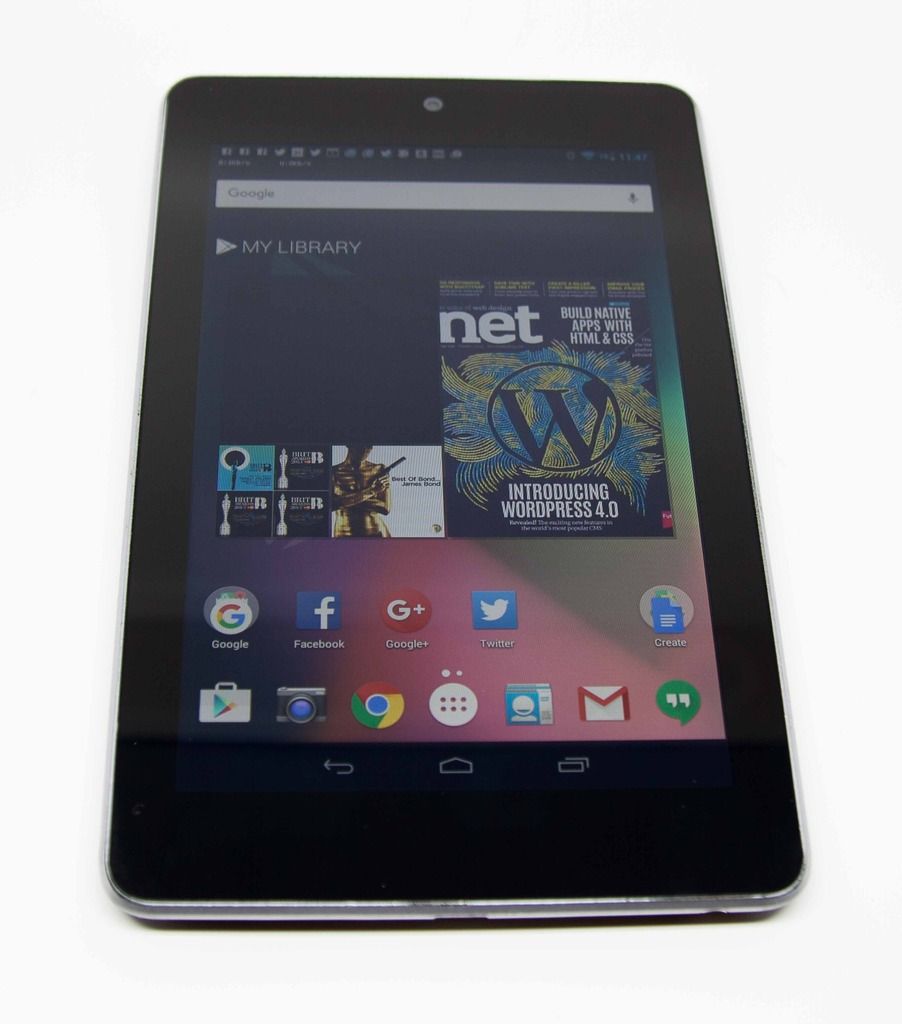
Android tablets were still a fledgling market in 2012 and to be frank the market was not in a good shape with few good choices of hardware. The Nexus 7 was a revelation in that it provided decent performance, pure Android, and, above all, a keen price (I'm sure I've heard/read reports that Google and/or Asus made little to no money on the tablet, with Google keen to get the product into as many people's hands as possible to show what Android tablets could do).
In December 2013 I bought myself a Nexus 7 from ebay. As I wasn't entirely sure how much I'd use a tablet I decided to go second hand and was planning to try and construct a working tablet from a couple being sold for spares on ebay. The tablet I ended up bidding on and winning cost me £56 and turned out to be a bit of a bargain. While it had been advertised as a faulty 16GB model, on receipt it turned out to be the 32GB variant. Also, contrary to the ebay listing, it appeared to be in full working order once I followed the instructions on Google's website for bringing back to life a Nexus 7 that had been allowed to run down its battery and not recharged for a while. That saved me at least £100 compared to what 32GB first generation Nexus 7s were selling for on ebay at the time.
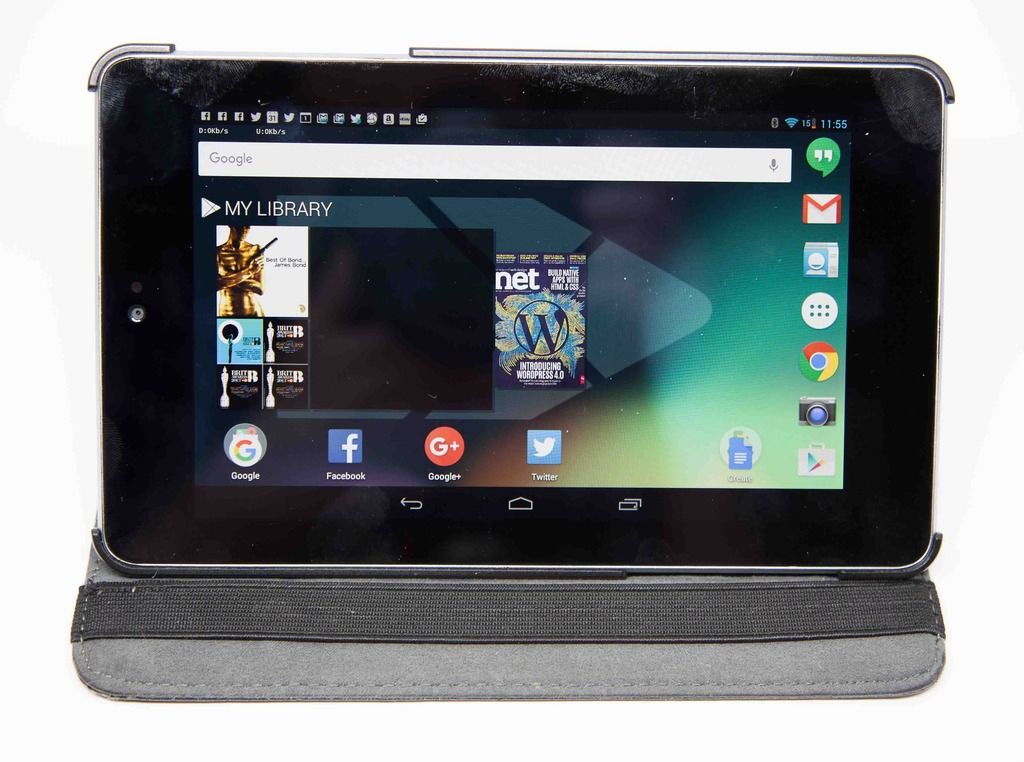
Once it was charged up I updated it to the latest version of Android available (one of the benefits of a Nexus device being that, for as long as the device is supported, you get OS updates pretty quickly) and it was a great little device for browsing the web when I couldn't use my laptop (normally when I had the cat on my lap) and as a media player for podcasts, video and films, plus a few short-lived goes at a few different games.
That was, of course, when I could actually use it. While I'd bought it so that I could figure out if I'd use a tablet or not, the wife seemed to be using it just as much as me, to the point that she eventually bought herself the 2013 version.
All was going swimmingly, until the launch of Android 5, codenamed Lollipop, around November 2014. Amongst the improvements the fifth version of Android was supposed to bring was better performance on low end devices. Unfortunately, this apparently didn't include the original Nexus 7. While my wife's 2013 model tablet seemed to take Lollipop in its stride, my 2012 edition was now beset by frequent slowdowns and lock-ups, often requiring a reboot to get things working again.
The main app I used on it, my podcast app Pocket Casts, became borderline unusable. I tend to listen to most podcasts at 1.6 times normal speed - due to the number I listen to I'd be months behind in listening to them otherwise - and this had pretty much worked fine when I was on the previous KitKat revision of Android. Now, however, the audio would frequently glitch - either cutting out for a few seconds or the audio stretching out and distorting. The app would also freeze, requiring a reboot to sort out.
Web browsing also became frustrating. What you'd have thought would be so processor-lite that it should run fine with three or four tabs turned into a chore. Video playback, whether from YouTube, or other apps like VLC, became unreliable. A sleepless night away from home for one of my wargaming events became more frustrating when the film I was trying to watch through Google Play kept glitching and freezing up to the point that if I hadn't been sharing the room with someone else who was sound asleep I'd probably have hurled the Nexus across the room.
In the end, I installed an Android 4.3 version of Cyanogenmod on it which brought performance most of the way back to what it had been, albeit still with occasional glitches and slowdowns that I did not recall having when the Nexus was previously on stock KitKat. Of course, with only subjective impressions of performance it's entirely possible that, after months of Lollipop's poor performance, I'm now far more sensitive to it than I was previously. I could probably try a few different ROMs for various point releases to see if they improved things but to be honest it'd be a lot of faffing around I don't really have time for.
Thus it was that while the Nexus was back in usable territory, I decided to begin searching for something newer (although that's a search that brings with it its own trials and tribulations which I'm sure I'll report on in the future).
Overall, considering its age, this is still a good device. With the lack of an SD card slot, the 32GB memory is a must if, like me, you plan to use your device away from home and so cannot be sure of reliable or decent speed WiFi connections. It's just a shame that you have to use the older OS if you want reasonable performance now.
Sunday, 30 August 2015
Introduction
While I have a number of interests and hobbies I only have time to partially indulge, I already have a blog for the hobby that currently seems to take up most of my time, miniature wargaming. (And which you can find here). This will be the blog for all my other interests.
My other interests include such traditional favourites as reading, listening to music, watching TV, going to the cinema etc but also photography and home cinema. I'd also say gardening, if only for the amount of my precious free time I seem to spend doing it rather than the amount of enjoyment I get out of it, as well as dreaming of the day we can afford to decorate the house and improve the garden...
I'm probably not going to be posting to this blog terribly regularly, more as and when I've got something I really want to post about and have time to put my thoughts in writing. (For example, I've already got several posts in preparation, I just don't know when I'll have time to flesh them out from the titles to something worth reading).
Anyway, enjoy what comes along.
My other interests include such traditional favourites as reading, listening to music, watching TV, going to the cinema etc but also photography and home cinema. I'd also say gardening, if only for the amount of my precious free time I seem to spend doing it rather than the amount of enjoyment I get out of it, as well as dreaming of the day we can afford to decorate the house and improve the garden...
I'm probably not going to be posting to this blog terribly regularly, more as and when I've got something I really want to post about and have time to put my thoughts in writing. (For example, I've already got several posts in preparation, I just don't know when I'll have time to flesh them out from the titles to something worth reading).
Anyway, enjoy what comes along.
Subscribe to:
Comments (Atom)